
A rain garden is a planted depression in the landscape that collects runoff from impervious surfaces — roofs, driveways, patios — and holds it temporarily while the water infiltrates into the soil beneath. The concept is straightforward; the details of getting it right in a Canadian climate are less so.
Canada's variable climate adds complications that Southern US rain garden guides don't address: frost penetration depths of 1–2 metres in some regions, spring snowmelt as a primary runoff event, and plant palettes limited to species tolerant of both extended saturation and winter cold. This guide focuses on those specifics.
What a Rain Garden Is Not
A rain garden is not a pond. It should drain completely within 24–48 hours of a storm. A depression that holds standing water for several days becomes a mosquito breeding area and a foundation risk. If a site drains in less than 24 hours, the design is working. If water stands beyond 48 hours, either the soil has been compacted during construction, the sizing is wrong, or the soil's native infiltration rate is lower than assumed.
Choosing a Location
Distance from Structures
A rain garden should be located at least 3 metres from any building foundation. The standard cited in most Canadian municipal stormwater guidelines is 3–5 metres. The reason is straightforward: a properly sized rain garden will occasionally reach full ponding depth during a large storm. Water at ponding depth 2 metres from a basement wall is a potential problem regardless of how well the soil drains under normal conditions.
Ten metres is a more comfortable buffer when working near an uninsulated or partially below-grade foundation. Check local municipal requirements — some Ontario municipalities specify minimum setbacks in their lot grading bylaws.
Topographic Position
Rain gardens work best on gentle slopes of 2–8%. On flat ground, getting water to the garden requires careful grading of the approach channel. On slopes steeper than 8%, rain gardens tend to overflow their inlet side and require retaining structures to maintain their shape.
The garden should sit downhill from the surfaces generating runoff. A roof downspout, for instance, can be directed to a garden via a gravel-lined channel or a buried pipe, as long as the garden sits at the lowest point of that path.
What to Avoid
- Low spots that are already naturally wet — these have poor infiltration and will stay saturated
- Locations directly over septic beds
- Areas with compacted subsoil from past construction activity (test by probing with a rod — if it won't penetrate 300 mm, subsoil amendment is needed)
- Directly beneath large tree canopies where root competition will be intense and canopy drip may overwhelm the design
Sizing the Rain Garden
The goal of sizing is to determine the rain garden's surface area and depth such that it can capture and infiltrate a target storm event — typically the 25 mm storm in most provincial guidance, which represents a common design storm for residential applications in Eastern Canada.
Catchment Runoff Volume
The runoff volume (V) from a surface during a storm is:
V = A × C × P
Where A is the catchment area in m², C is the runoff coefficient (0.95 for asphalt/concrete, 0.5 for compacted lawn, 0.9 for roof), and P is the design precipitation in metres. For a 100 m² roof draining to a single rain garden in a 25 mm storm:
V = 100 × 0.90 × 0.025 = 2.25 m³
Required Ponding Volume
The rain garden must store this volume within its ponding depth (typically 0.15–0.20 m). For a rectangular garden with 4:1 side slopes and a 0.20 m ponding depth, the required surface area at the bottom of the bowl is approximately:
Area = V / ponding depth = 2.25 / 0.20 = 11.25 m²
A garden roughly 3 m × 4 m at the base would handle this. The sloped sides add additional volume that acts as a buffer, so this calculation is conservative.
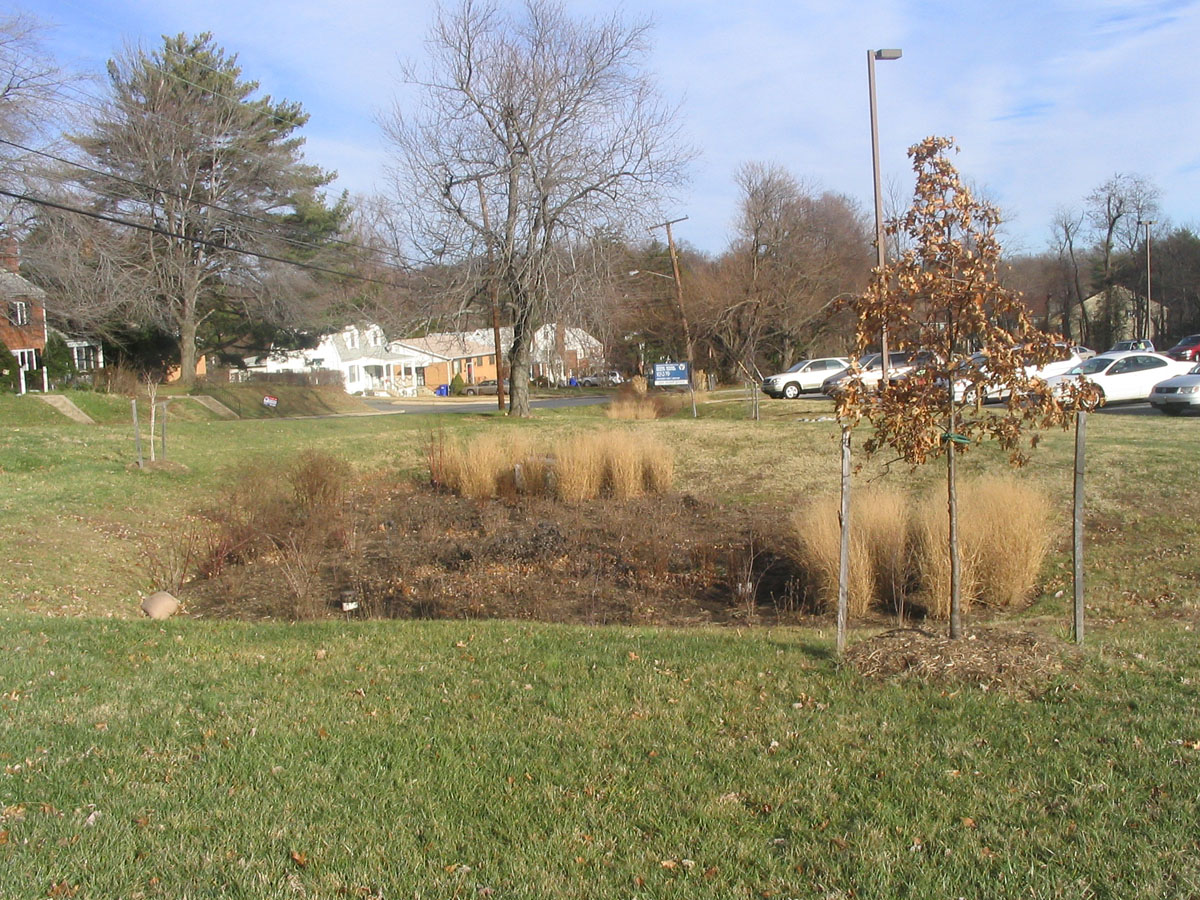
Soil Preparation
The native soil in many Canadian residential lots — particularly in subdivisions developed post-2000 where topsoil was stripped and subsoil compacted during construction — has infiltration rates far below the natural landscape. Before building a rain garden, a soil test or percolation test is essential.
Amending the Soil Mix
Most rain garden guidance recommends replacing the native soil in the garden's ponding area with an engineered soil mix. The US EPA rain garden guidance (widely referenced in Canadian municipal design guides) recommends:
- 50–60% coarse sand
- 20–30% compost
- 20–30% topsoil
This mix achieves an infiltration rate of 25–50 mm/hour under most conditions — adequate for draining a 25 mm storm event within 24 hours even at the lower end of the range.
Depth of Soil Replacement
For the amended mix to function, it needs to extend below the frost line far enough that the native soil beneath it remains permeable through freeze-thaw cycles. In Southern Ontario, replacing 450–600 mm of soil is standard. In Manitoba or Northern Ontario, where frost penetrates deeper, some practitioners excavate 750–900 mm and backfill partially with drainage gravel before the amended soil layer.
Plant Selection for Canadian Rain Gardens
Plants in a rain garden need to tolerate two conditions that rarely occur together in natural habitats: periodic inundation (the bowl during and after a storm) and dry periods between rain events, particularly in summer. In Canada, they also need to be cold-hardy to at least Zone 4 or 5 for most of the country.
Bottom Zone (Inundation-Tolerant)
- Iris versicolor — Blue Flag Iris, native across Eastern Canada, tolerates standing water for several days
- Carex stricta — Tussock Sedge, forms dense clumps, excellent for stabilising the rain garden base
- Lobelia cardinalis — Cardinal Flower, showy, attracts hummingbirds, tolerates wet feet
Middle and Upper Slope Zone
- Rudbeckia hirta — Black-Eyed Susan, tolerates moist and dry conditions, self-seeds readily
- Echinacea purpurea — Purple Coneflower, drought-tolerant once established, good for the upper slope
- Andropogon gerardii — Big Bluestem, deep roots improve infiltration in the middle zone
Mulch Layer
A 75 mm layer of shredded hardwood mulch on the garden's sloped sides reduces weed pressure and moderates soil temperature. Avoid rubber mulch (no infiltration benefit) and fine wood chip mulch (floats during high water and escapes the garden). Renew mulch every two to three years.
Winter Behaviour and Spring Management
A frozen rain garden is not a functional rain garden. In most Canadian climates, the ponding area will be frozen from December through March, and the spring snowmelt event — which can generate as much runoff as multiple summer storms combined — will arrive before the soil has thawed.
This is one reason Canadian rain garden designs often include an overflow channel: a gravel-filled or sodded path at the garden's highest point that routes overflow away from the structure toward a street inlet or natural drainage feature. The overflow needs to be sized for a condition where the garden's soil is frozen and 100% of inflow becomes overflow.
Permit Considerations
In most Canadian municipalities, a rain garden on a private residential lot does not require a building permit. However, grading changes within 0.3 m of a property line, or changes that redirect flow toward a shared driveway or neighbouring property, may trigger a lot grading review. Check with your local municipality's engineering department before starting work. Many offer free pre-application consultation for lot grading questions.